Reducing the energy that your home needs will not only save you money, but it will also lessen the demand on the power grid.
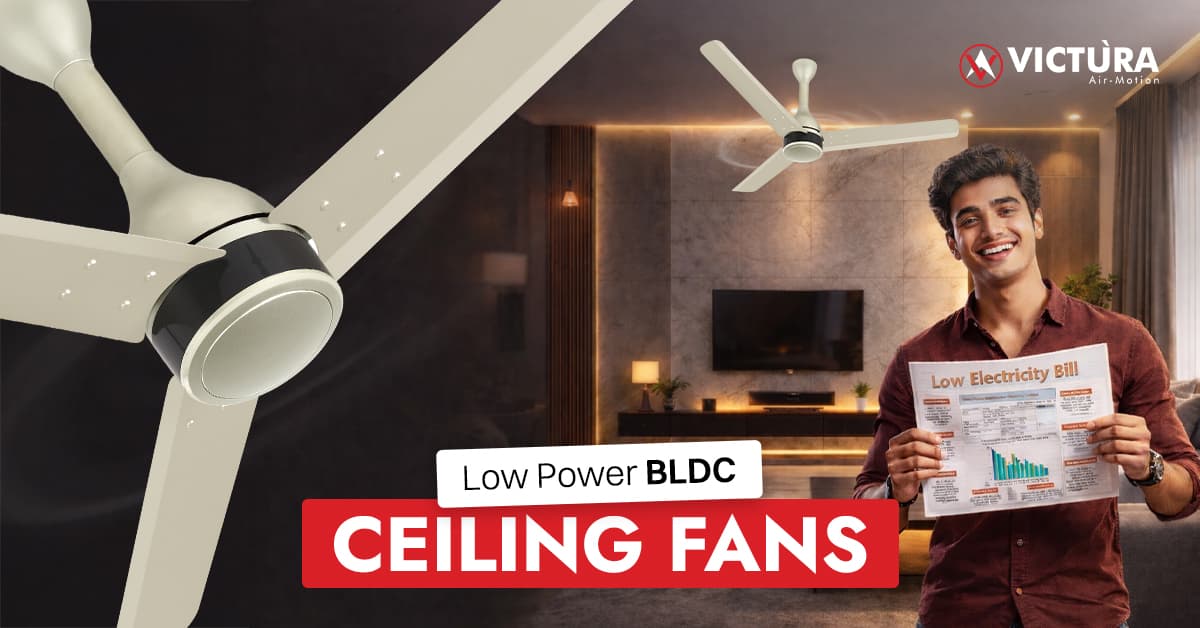
Cut the cord on high energy bills with low power BLDC ceiling fans. BLDC is for saving power through a fan in the same way LED is for saving power through light.
As energy prices climb, homeowners are jilting traditional induction suckers for Brushless Direct Current (BLDC) technology. While an old technology fan gulps down 75–80 watts, an energy-effective BLDC model fan sips just 28-35 watts.
This post explores how these smart motors work, the math behind the massive yearly savings, and why switching to BLDC is no longer just an eco-friendly choice, but a financial necessity for the modern household.
BLDC stands for Brushless Direct Current, that much you might already know. But the motor inside is the real deal.
Fans that use traditional induction motors use up too much power, make a lot of noise and just don't give high airflow. And while doing all that, it gives off a lot of heat too. That heat is literally wasted, drifting into the air.
BLDC motors scrap the brushes entirely. They use permanent magnets and an electronic controller to manage the rotation.
Because no friction-induced heat occurs, almost 100% of the energy pulled from the socket goes directly into turning the blades. It is a cleaner, more efficient way to move air.
The power gap between an old-school fan and a BLDC model is staggering. Look at the numbers: a typical induction fan runs at 75W, while a BLDC model stays between 28W and 35W.
Think about the annual impact. If a fan runs for 12 hours a day at an average rate of ₹7 per unit, a traditional fan costs roughly ₹2,300 per year to operate. A BLDC fan doing the exact same work costs only about ₹900.
When you multiply that by five or six fans in a house, the savings become massive. Even though BLDC fans have a higher upfront price tag, the energy savings usually pay back that "premium" within 12 to 24 months.
After that, the fan is essentially putting money back into your pocket every single month.
Efficiency is the main hook, but the daily experience is what keeps people happy.
Whisper-Quiet Operation: You can finally say goodbye to that annoying "hum" or "buzz" that old motors develop over time. BLDC fans are famously silent.
Inverter Friendly: During a power outage, a BLDC fan runs up to three times longer on a home inverter than a standard fan. This is a game-changer for staying cool during long blackouts.
Voltage Stability: These fans maintain a consistent speed even when the voltage fluctuations hit. No more slowing down just because the grid is struggling.
Smart Features: Most BLDC fans come standard with remote controls, sleep timers, and even app integration, so you never have to get out of bed to change the speed.
Reducing the energy that your home needs will not only save you money, but it will also lessen the demand on the power grid. For every watt that is saved, a ton of coal need not be burned or a lesser quantity of gas is consumed at the plant.
Life span is also very important when talking about environmental friendliness. As BLDC motors are brushless and therefore do not have parts that wear down, these fans are said to be able to last 10 to 15 years without any problem.
By choosing a sturdy, highly energy-efficient product, you are lessening the amount of electronic waste and making your home a true "Green Home".
Ready to shop? Keep these three metrics in mind:
BEE Star Ratings: Check the Bureau of Energy Efficiency labels. A 5-star rating ensures top-tier energy savings.
Sweep Size: Match the blade span to the room. Use 900mm for kitchens or small bathrooms and 1200mm for standard bedrooms and living areas.
Air Delivery (CMM): Don't trade comfort for savings. Ensure the fan has a high Cubic Meters per Minute (CMM) rating so the airflow feels just as strong as your old "power-hungry" fan.
Also Read: What is a Star Rating in Fans and Why It Matters
Some people hesitate because of the price, but the "expensive" tag is a myth when viewed over the fan's lifespan. You are paying up front to avoid high monthly bills later.
Another common worry is speed. Modern BLDC fans often deliver higher RPM and better torque than traditional models. As for repairs, while the electronics are specialized, major brands now have extensive service networks across the country.
The reliability of these motors actually makes them less likely to fail than their friction-heavy predecessors.
Another important thing that you should always have in mind while changing is the wall regulator. As BLDC fans are equipped with their own remotes, the step regulator that you used on your wall becomes unnecessary.
To get the optimal output, one should definitely either remove the old regulator or keep it at the maximum position all the time. A standard regulator used to "dim" the power to a BLDC fan can mislead the internal electronics and eventually the unit may not function for a longer time.
One of the simplest changes to prepare a home for the future is to replace an old fan with a low power BLDC fan. A mere change of a cooling appliance is what you think you are doing when you make the switch.
But in reality, you are moving to a quieter, smarter and more environmentally friendly way of living which is self-paying. Don't continue to pay more than necessary for your comfort, and begin to notice the difference in your next utility bill.
Audit the fans in the most-used rooms today and calculate the potential savings. Browse through Victura Airmotion’s latest BLDC models online or share this guide with anyone looking to shave some numbers off their monthly expenses!
Absolutely. The modern BLDC models are designed to match or exceed the air delivery (CMM) of the standard ones. Always check the CMM standing on the box to ensure it meets your comfort needs for a specific room size.
Yes, they handle them better than standard fans. The internal electronic regulator acts as a stabilizer, allowing the fan to run at a constant speed indeed when the input voltage drops as low as 140V or even lower.
While the internal circuitry is more advanced, it’s not infallible. Go for a good brand that’ll offer 2-5 years of warranty. Repairs generally involve a simple exchange of the electronic PCBA (circuit board) rather than a complex motor rewind.
Yes, a bit. The original purchase price is higher than a traditional induction fan, but the long-term cost is much lower. Since you save significantly on yearly electricity bills, the BLDC fan generally pays for itself through energy savings within 1 to 2 years.
Look for the BEE (Bureau of Energy Efficiency) Star Marker. A 5-star rated BLDC fan is the most effective. Also, check the wattage; a true low power BLDC addict should consume between 28W and 35W at the loftiest speed.
Apart from power saving, look for high Air Delivery (CMM) to ensure a strong breeze, a silent motor for better sleep, and a long bond period. Features like sleep timekeepers on the remote control are also helpful for managing comfort through the night.
Keep moving with bright ideas. From the way air moves to clever home hints, our blog is your place to dive into ease, style, and smart energy use.